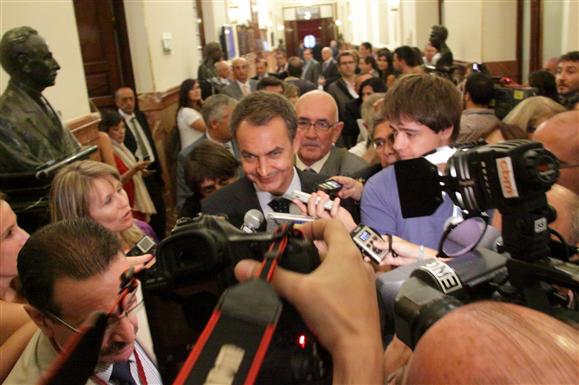
A swiftly agreed, bi-party accord to safeguard the Spanish economy’s future. It should be music to every Spaniard’s ears. The governing Socialists and opposition Popular Party have finally reached consensus on a major issue, putting aside their ideological differences and petty electoral interests to introduce a constitutional reform that puts a cap on the public deficit. Such statesmanship harks back to the spirit of the Transition.
Or does it?
Having heeded the plea by the French and German leaders for deficit controls to be enshrined in eurozone magna cartas, José Luis Rodríguez Zapatero and Mariano Rajoy have responded. This extraordinary measure, they argue, will calm the jittery speculators who have been causing Spanish bond yields to soar in recent weeks.
Once the details are in place, it would seem to at least control the deficit, which in Spain’s case has been a major cause of the market rollercoaster ride. But it’s not the only cause. The government has made a huge effort to bring the deficit under control and if its 6-percent-of-GDP target for 2011 is at all accurate, then it is on the way to doing just that. Yet the markets have also been deeply unimpressed by other indicators, such as sluggish growth that has seen Spain barely emerge from the recent recession – and even look like slumping back into it in the coming months. There’s also the matter of a 21-percent jobless rate.
As August’s eurozone bond madness showed, the markets aren’t strictly rational. And a reform like this is no guarantee against further turmoil, especially as it is likely to contain loopholes. But aside from the purely economic dimensions of this unprecedented accord, it also carries substantial political ramifications.
The Socialists and PP were in such a hurry to reach their deal that they failed to consult other parties. Clearly, many of those would have opposed the measure, but the way it has been rushed through reinforces the image that Spain is run by a bi-party club, one that not only controls the country’s political, economic and judicial institutions, but which can also meddle with the Constitution at the drop of a hat.
This perceived carve-up was among the main catalysts of the 15-M protest movement and the fact that calls for a referendum on the issue have been rejected further distances Spain’s already aloof political class from those it represents.
But the constitutional reform also tells us something about the state of mind of those that hatched it. With it, Zapatero completes his abandonment of the social-democrat ideals upon which he based his first years in office and further alienates the Socialist voters who might have helped his candidate, Alfredo Pérez Rubalcaba, close the gap on the PP in November’s election. “[Zapatero] came into office promising to change Spain, and as always happens, the world has changed him,” wrote columnist Josep Ramoneda in El País.
For Rajoy, this is probably his most statesmanlike act in seven years, even though it appears to be a PP initiative. It also shows that having long refused to lay out details of an economic plan, he is perhaps finally preparing to get real about the task that faces him after November. Although the current prime minister’s deficit-capping drive is driven by a spirit of resignation, Rajoy’s seems to be driven by fear at what lies ahead.
Leave a Reply
You must be logged in to post a comment.