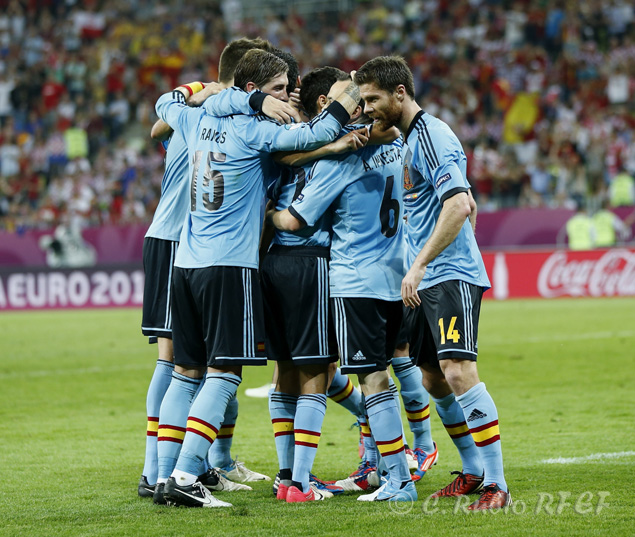
It took a whole 88 minutes and a careful finish by Jesús Navas, but Spain have qualified from their group to advance to the quarterfinals and keep alive their dreams of winning three major international tournaments back-to-back. Just.
The relief was palpable. Before the breakthrough came, with Italy winning against the Republic of Ireland in the tightly contested group, a Croatia goal would have sent the reigning European and world champions home.
The Spanish TV commentators insisted that everything was fine and going according to plan, but a nation was biting its nails, hurling abuse at the screen and collectively holding its breath as Iker Casillas was forced to make two crucial saves. After the game, the captain himself would admit to the players’ nerves.
The win followed an all-too-familiar theme for La Roja, who went into the tournament as strong favourites but have only fleetingly looked their all-conquering selves. As many predicted, the loss of David Villa has proved a big blow and so far, despite having the likes of strikers Fernando Torres, Fernando Llorente and Álvaro Negredo in the squad, the team has lacked firepower.
Before their first group game against Italy, all talk was of who would start up front. Some predicted coach Vicente del Bosque would stay loyal to Torres despite his poor goal return this season and lack of confidence. Others expected Llorente – coming off the back of his best season so far – to lead the line and some even backed Sevilla’s Negredo. The former Real Madrid manager however, blindsided everyone by playing without a true number nine as the side kicked off their title defence against the Azzurri.
Instead, Cesc Fàbregas was brought in and though the only Spanish goal in that 1-1 draw came from the Barcelona man himself, with a total of six midfielders on the pitch, the team had not impressed. They were as José Mourinho put it, “sterile” without a focal point up front.
They say a week is a long time in football and so it was only four days later that Spain took on the Republic of Ireland in their second group fixture. Having faced a torrent of criticism for his tactics at the weekend, Del Bosque opted to start a striker and chose Torres. Hungry to get off the mark in the tournament and eager to prove his critics wrong, El Niño justified his starting spot with two goals in a 4-0 drubbing of the Irish.
Sports daily Marca called it a footballing lesson in control, precision and effectiveness with a display that saw the Spanish retain 72 percent possession.
While Ireland were not much of a challenge, the performance eased the pressure and as if to further calm nerves, on the eve of the third and final group game against Croatia, it was announced that Del Bosque had signed a contract extension for a further two years ensuring he would be in charge of the team at the next World Cup in Brazil 2014.
However, almost as soon as the whistle blew to bring the game against the Irish to a close, Italy started talking of a conspiracy between the Spanish and Croatians to play for a 2-2 draw which would take both sides through and knock out the Italians, who might prove tricky opponents further down the line.
In the end, such fears proved unfounded as Spain struggled to get just the one goal and while a 2-2 result may not have been on their minds, with the group so incredibly tight, the players were well aware that a 0-0 result would suffice but a loss would not.
As the minutes ticked by, however, Croatia looked more threatening and were unlucky not to be awarded a penalty five minutes from time when Sergio Busquets dragged down Vedran Ćorluka as he was ready to head in from two metres.
Spain needed a goal to ensure their progress and it eventually, arrived not from Torres, who had been included in the starting 11, but from substitute Navas.
In the final minutes of the game, another substitute, Fábregas, dinked the ball over the top to Andrés Iniesta, who beat the offside trap, chested it down and squared to Navas, who took care to ensure he was less than a yard out before smashing it into the net.
As group winners, Spain will now meet the runners-up of Group D – either France, England or co-hosts Ukraine. But if La Roja want to defend their European crown, they quickly need to add some aggression to their game, as well as the ability to score with more ease.
Leave a Reply
You must be logged in to post a comment.