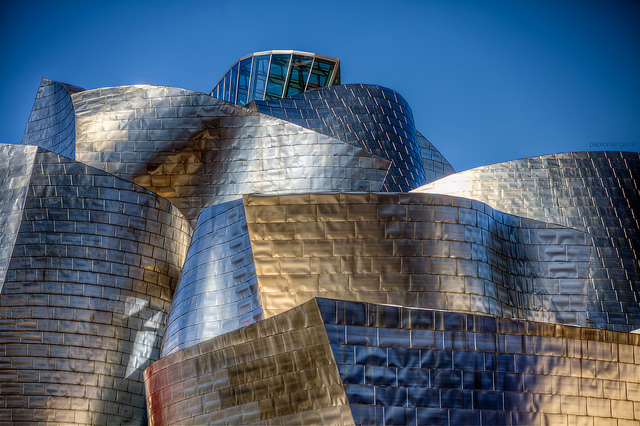
When Frank O. Gehry won a limited competition to design Bilbao’s new art museum in the early 1990s, the idea was to turn an old brick factory along a bend in the Nervión River into a cultural focal point for a city that had seen its traditional industries, such as shipbuilding and mining, virtually disappear by the late 20th century.
Gehry had designed the Fish (1992) sculpture for Barcelona’s Port Olímpic, utilizing computer-aided design (his first use of CAD for a major project) to model its sweeping curves. In Bilbao, he would employ similar methods, resulting in what appear to be random organic forms (reminiscent of billowing sails) with the combination of seemingly incongruous titanium, stone and glass.
An orthogonal plan with a central atrium and surrounding exhibition spaces changed the usual museum path that tended to have galleries lead one into another. Its broad spaces allow the indoor exhibition of large-scale and site-specific sculptures, such as Richard Serra’s Snake, that would otherwise only be found in outdoor settings.
The result is a Guggenheim that rivals its predecessor in New York (designed by Frank Lloyd Wright), and forms a visual trademark for the city of Bilbao. It continues to solicit both positive and negative criticism over its design, its effect on the city and on an increasingly globalized museum culture. The museum is one of the major tourist attractions of the Iberian Peninsula, with over 10 million visitors since its opening. Frequently cited as a key example of late-20th century architecture, it has even found itself within the canon of art history.
Bilbao, along with its Berlin counterpart, marked the initial forays for the Guggenheim Foundation to move beyond American shores since joining the Peggy Guggenheim Collection Venice in the 1970s. Its international expansion has influenced other museums such as the Louvre and the Centre Pompidou. For example, in April 2012 the Centre Pompidou announced an initiative for its own expansion centering on the BRIC countries.
Delays and wrangles
The road towards establishing the Guggenheim Museums as a global brand has not been entirely smooth since the opening of Bilbao nor have some of Gehry’s other Iberian Peninsula-based projects. After the opening of Bilbao’s museum, Gehry was chosen to redesign Lisbon’s theatre district, Parque Mayer. Plagued by political wrangles, the project was never realised.
Guggenheim Abu Dhabi (also designed by Gehry) has been re-scheduled for a 2017 opening, reflecting an overall delay in completing the Saadiyat Island Cultural District (Jean Nouvel’s Louvre Abu Dhabi and the Norman Foster-designed Zayed National Museum are set to open 2015 and 2016 respectively). On May 3, 2012, the city board of Helsinki rejected a €140-million project for a museum along its waterfront. Berlin’s Deutsche Guggenheim (opened in the same year as Bilbao) is now slated to shutter its doors at the end of 2012.
Given such setbacks and the current state of the world economy, the future of the Guggenheim experiment and Gehry’s ongoing role in it are unclear. What is certain is Guggenheim Bilbao’s unique place in the late 20th century’s cultural landscape.
Leave a Reply
You must be logged in to post a comment.